
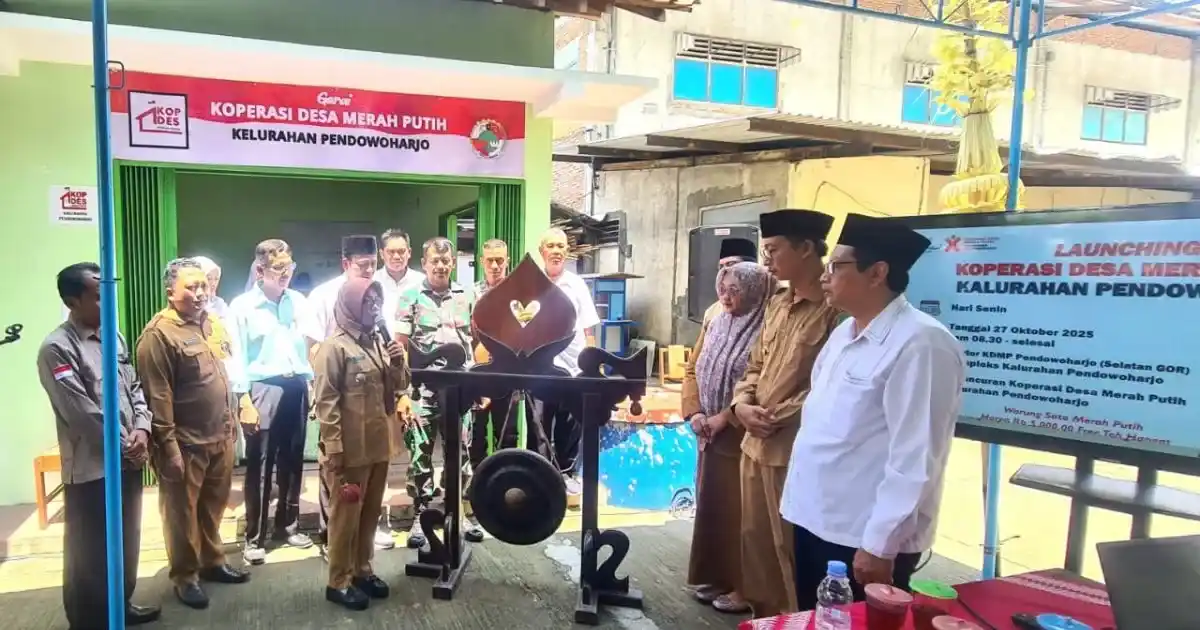
Sewon. On Monday, October 27, 2025, a significant milestone was reached in Kapanewon Sewon, Bantul Regency: Panewu Sewon, Hj. Hartini, S.IP., M.M., officially inaugurated the “Koperasi Desa Merah Putih” (KDMP) in the two villages (kalurahan) of Timbulharjo and Pendowoharjo, marking an important step toward economic self-reliance at the local level. (kec-sewon.bantulkab.go.id)
In her opening remarks, Hj. Hartini emphasized that KDMP is much more than a financial entity — she called it a key pillar (“soko guru”) for village-level economies. Her hope is that these cooperatives will drive fair, sustainable development and strengthen the economic resilience of the community. (kec-sewon.bantulkab.go.id)
Local Business Units: Where Community Meets Commerce
To celebrate the launch, each KDMP opened a business outlet (unit usaha) in its respective village:
- Timbulharjo: A canteen and a coffee shop located within the village office complex. This venue is not only a business but also a social hub where residents can gather, network, and support local enterprises. (kec-sewon.bantulkab.go.id)
- Pendowoharjo: A Soto food stall was launched, capitalizing on local culinary traditions as a first step toward a stronger village-based food economy. (kec-sewon.bantulkab.go.id)
Looking ahead, both cooperatives plan to diversify. They aim to expand into agricultural production, waste management, trade, and even microfinance services — tailoring their offerings to what the community needs and can sustain. (kec-sewon.bantulkab.go.id)
What Is “Koperasi Desa Merah Putih” (KDMP)?
KDMP is a nationally-driven program, initiated by the Indonesian Ministry of Villages, Development of Disadvantaged Regions, and Transmigration (Kemendesa PDTT). (kec-sewon.bantulkab.go.id) Its core mission is to strengthen the role of BUMDes (Village-Owned Enterprises) by pooling community economic power, building something beyond just a business: a cooperative rooted in mutual help, local production, and shared ownership. (kec-sewon.bantulkab.go.id)
By operating on principles of gotong-royong (mutual cooperation) and collective ownership, KDMPs are expected to help reduce economic inequality, foster local social resilience, and empower villagers to become active economic participants. (kec-sewon.bantulkab.go.id)
This initiative is part of a larger, nationwide push. The Indonesian government has launched over 80,000 Merah Putih village-level cooperatives, showing serious commitment to building an inclusive, people-powered economy. (Setneg)
Monitoring, Support, and Future Outlook
The operational readiness of KDMP in Sewon (Timbulharjo and Pendowoharjo) has been closely monitored. According to the Sewon subdistrict administration, there are active efforts to recruit more members — including civil servants (ASN), local institutions, and ordinary residents — as their participation is considered vital for the cooperative’s long-term success. (kec-sewon.bantulkab.go.id)
Funding-wise, some of the start-up capital for cooperatives comes from village-level funds (PPBMP), especially to support less-advantaged community members, aligning with the model’s goal of equitable economic inclusion. (kec-sewon.bantulkab.go.id)
Key local officials have also been involved: in Timbulharjo, for example, a “Musyawarah Kalurahan Khusus” (special village meeting) was held in May 2025 to establish KDMP’s structure, governance, and business units. (Timbulharjo)
Moreover, there are goals to expand the cooperatives’ economic functions — such as opening a groceries (sembako) outlet, which could help stabilize staple food prices and improve the supply chain for essential goods in the village. (Timbulharjo)
Why This Matters
- Economic Empowerment: By pooling resources, KDMP provides villagers with a platform to become producers, distributors, and consumers — not just beneficiaries.
- Social Resilience: Through shared ownership and cooperation, communities can build stronger social bonds and reduce reliance on external economic actors.
- Sustainable Local Growth: The planned diversification into agriculture, waste management, and microfinance shows a long-term vision — one that’s deeply rooted in local potential.
Comments