
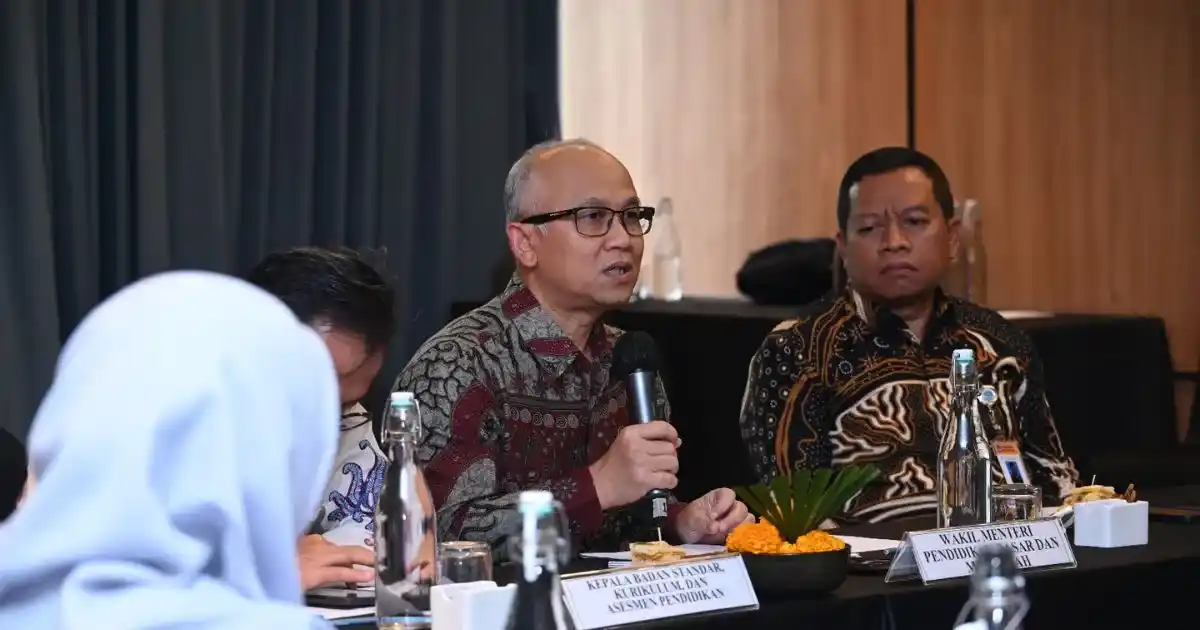
Jakarta. In a bid to fortify a national educational policy that is adaptive to technological progress, the Ministry of Primary and Secondary Education (Kemendikdasmen) continues to advance a responsive educational agenda aligned with the digital era. The commitment was underscored during the “Digital Education Transformation” public consultation for the Draft National Education System Law (RUU Sisdiknas).
Deputy Minister Atip Latipulhayat officially closed the event in Bali, delivering remarks that the RUU Sisdiknas must be capable of adapting to rapid technological and social change. He emphasized:
“What we discuss today is how technology becomes part of an integrated learning ecosystem. For example, coding is not just an elective subject, but a tool to reinforce the entire learning process.”
In his address, Deputy Minister Atip pointed out that the application of technology in educational institutions represents a significant breakthrough for both teachers and students. He referenced the successful example of Sekolah Cendekia Harapan Badung in Bali, which integrates school infrastructure and the learning process into artificial intelligence (AI) and coding.
“We want the RUU Sisdiknas to answer educational challenges not only for the present, but also for the future. Many provisions must be updated so that they align with technological developments and educational needs,” he added.
Meanwhile, Muhammad Yusro, Secretary of Badan Standar, Kurikulum, dan Asesmen Pendidikan (BSKAP), said that technological and AI literacy need to be established as a national core competency so that students not only become users, but creators of technology. He also highlighted the importance of digital ethics and security as national norms in the digital transformation era.
“Digital ethics, privacy, and data security must become national educational norms. Government, academia, and industry need to build a collaborative ecosystem to develop national AI education and ensure equitable access to ICT,” said Yusro.
The event featured speakers from multiple sectors. From the regulatory side, expert drafter Ricko Wahyudi of the Legislative Drafting Agency of the DPR RI explained that the RUU Sisdiknas has entered the 2025 Priority National Legislation Program and is currently under review by Commission X. He noted that the drafting of the RUU Sisdiknas involves various stakeholders via public participation, including regulators and academics in the education sector.
From the infrastructure side, Wahyu Adi Dana Prasodjo of the Kementerian Komunikasi dan Digital (Ministry of Communication and Digital) said that educational digital transformation is not just about digitising tools, but a holistic change in how we teach, learn, and manage education.
“Technology enables remote learning, digital classrooms, and learning-data analysis to improve curricula. With school-management digitisation, efficiency and transparency can increase,” he explained.
Through this initiative, the Ministry reaffirmed its commitment to continuously open dialogue with education stakeholders so that national education regulations can address the demands of the times. Digital transformation is not optional — it must support social justice, broaden access, and deliver Quality Education for All.
Comments