
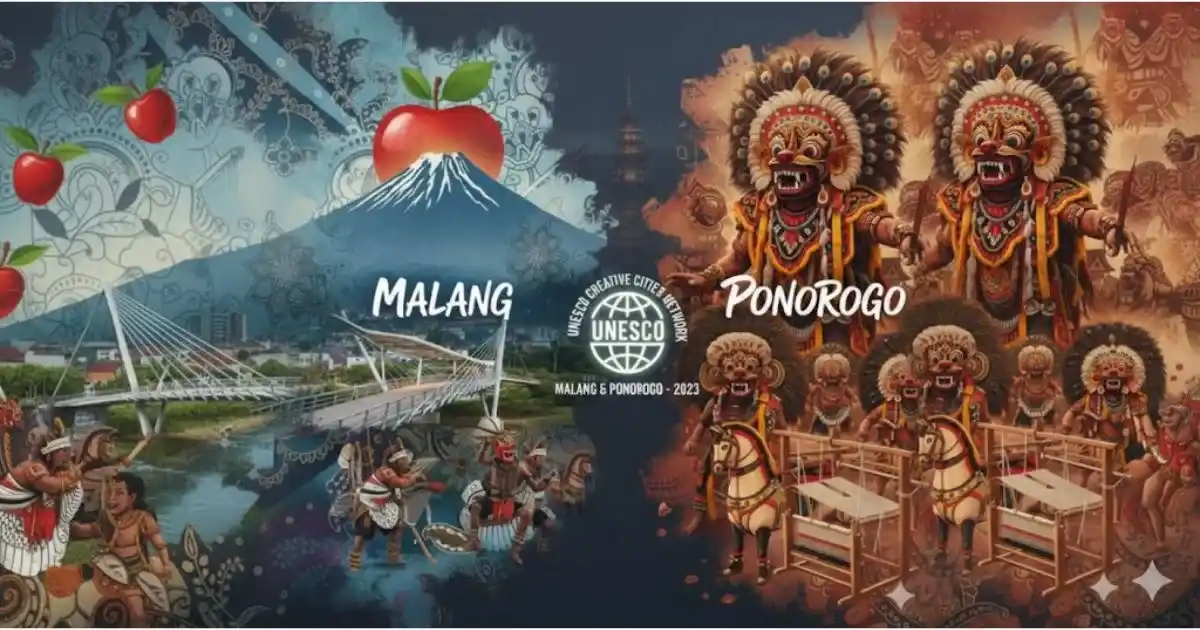
Indonesia. On 1 November 2025, the UNESCO officially announced that the Indonesian cities of Malang and Ponorogo have been added to the UNESCO Creative Cities Network (UCCN), becoming part of 58 new global member cities.
This marks a strategic milestone for Indonesia’s creative economy and cultural diplomacy—highlighting that creativity now spans both deep-rooted cultural traditions and cutting-edge media arts across the archipelago.
Why Ponorogo? Roots in Crafts & Folk Art
Heritage meets innovation
Ponorogo was selected under the UCCN category Crafts & Folk Art, reflecting its rich cultural ecosystem.
Notably:
- The traditional performance Reog Ponorogo—with its majestic lion-and-peacock mask, dynamic dancers and horse-figures—is embedded in the region’s identity.
- Beyond performance, there is a supporting craft economy: mask-makers, costume artisans, folk-music groups, and local‐scale festivals all contribute to the region’s livelihood.
- Local government notes that approximately 24,840 people are involved in the Reog ecosystem, with annual turnover of more than Rp 5.4 billion from 365 registered Reog groups.
Opportunity for investors & creative entrepreneurs
- For craft-industry investors and social-impact operators: Ponorogo offers a supply chain of traditional craft + folk performance + tourism platform.
- For cultural-tourism operators: Bundling Reog-workshops, artisanal visits and heritage tourism could deliver authentic experiences.
- For local stakeholders: The UCCN designation places Ponorogo on the global map—opening access to international networks, funding, and creative exchanges.
Why Malang? Media Arts & the Digital Creative Economy
From student city to creative media hub
Malang, in East Java, enters the UCCN under the category Media Arts.
Key points:
- Malang has been developing its ecosystem in game development, animation, digital storytelling, and makerspaces—supported by universities and young creative communities.
- The city is the first in East Java to earn this recognition in Media Arts, positioning it alongside global media-arts centres.
- The status aligns with wider urban-development goals: digital creativity, job creation in the creative economy, and global linkage.
Why this matters for stakeholders
- For creative-tech investors: Malang offers a local base with digital-creative talent, institutional support and international recognition.
- For start-ups in games / animation / VR/AR: The UCCN network paves the way to collaborations, residencies, export of IP/content.
- For tourism and city-branding: Malang’s identity evolves from “student city / cool destination” to “creative-economy powerhouse”.
Indonesia’s Growing Creative Cities Portfolio
With the inclusion of Malang and Ponorogo, Indonesia now counts seven UCCN member cities. These include:
- Pekalongan – Crafts & Folk Art (2014)
- Bandung – Design (2015)
- Ambon – Music (2019)
- Jakarta – Literature (2021)
- Surakarta (Solo) – Crafts & Folk Art (2023)
- Ponorogo – Crafts & Folk Art (2025)
- Malang – Media Arts (2025)
This diversified portfolio shows Indonesia covering multiple creative domains: crafts, design, music, literature, media arts. It positions the country as a strong player in global creative-city networks.
From Recognition to Action: What’s Next?
The mandate behind the badge
The UCCN designation is not merely ceremonial—it carries expectations: international cooperation, knowledge exchange, four-year action plans, local implementation.
Key strategic areas
- Action plans & governance – Both cities should develop 4-year action frameworks aligned with UCCN guidelines.
- International collaboration – Access to global practice: e.g., Malang linking with media-arts hubs such as Changsha or Gwangju.
- Local ecosystem strengthening – Craft clusters in Ponorogo; creative tech communities in Malang. Must ensure inclusive development.
- Branding & tourism – Leverage the status to boost creative tourism: workshops, festivals, residencies, export of creative products.
- Measurement & sustainability – Define KPIs: jobs created, creative enterprises growth, heritage preservation, cross-city exchanges.
For Investors, Creatives & Tourists: What to Watch
Investors & business-leaders
- Look for craft-industry supply-chains in Ponorogo: mask-making, costume production, artisan clusters.
- In Malang: creative tech start-ups, game/animation studios, digital storytelling hubs.
- Trigger points: UCCN recognition often improves city’s attractiveness for grants, partnerships, and brand value.
Creative practitioners & community leaders
- Tap into new networks: UCCN offers platforms for residencies, festivals and cross-city creative projects.
- In Ponorogo: explore how tradition + innovation merge (e.g., modern interpretation of Reog performance, craft tech).
- In Malang: join or initiate maker-spaces, digital‐arts collaborations, young creative communities.
Tourists & cultural travellers
- Consider creative-city themed itineraries: visit Malang’s creative hubs + digital-arts exhibitions; visit Ponorogo’s Reog performance, artisan villages, craft workshops.
- The experience shifts from passive sightseeing to participatory creativity: try a mask-making class, attend a game-jam, experience a Reog rehearsal.
Conclusion
The induction of Malang and Ponorogo into the UNESCO Creative Cities Network is a breakthrough for Indonesia’s creative-city agenda. It signals that the country is serious about using culture, creativity and innovation as drivers of sustainable urban development.
For stakeholders—whether investing, creating or travelling—the moment has arrived to engage with these cities not just as destinations, but as dynamic creative ecosystems. The badge is real; the work has just begun.